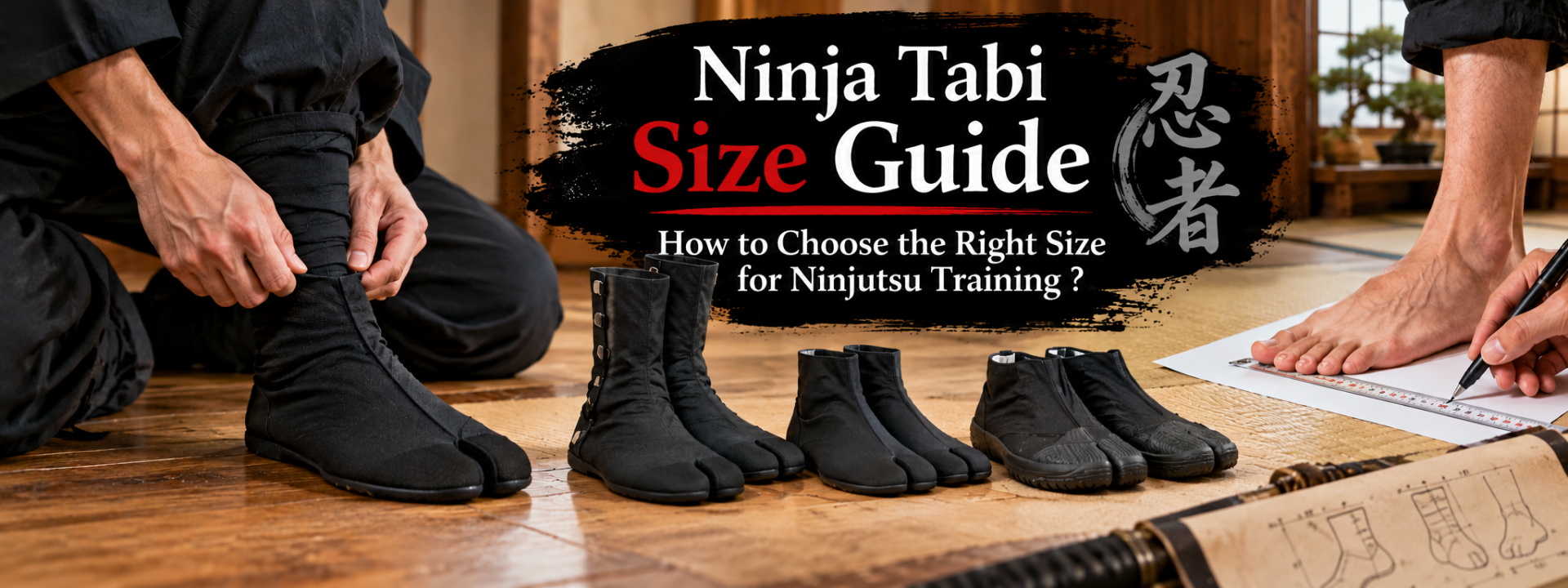
Ninja Tabi Size Guide: How to Choose the Right Size for Ninjutsu Training
Choosing the correct size of Japanese Ninja Tabi (忍足袋) is essential for comfortable and effective Ninjutsu training, Ninpō Taijutsu, and traditional Japanese martial arts practice.
Unlike ordinary footwear, traditional Japanese Tabi feature a distinctive split-toe design that separates the big toe from the remaining toes.
Their flexible construction allows the foot to move naturally during martial arts training.
For indoor Ninjutsu practice, particularly on tatami mats or suitable wooden dojo floors, choosing properly fitted Tabi helps prevent excessive fabric movement, uncomfortable folds, and unnecessary restrictions.
In this comprehensive guide, NinjutsuShop.com, a Kyoto-based specialist in Japanese Ninjutsu equipment, explains how to measure your feet, understand Japanese Tabi sizes, and choose appropriate footwear for your martial arts training.
What Size Ninja Tabi Should You Choose?
Quick Answer: Measure your foot while standing, from the back of your heel to the tip of your longest toe.
The measurement in centimeters is your primary reference for choosing Japanese Tabi sizes.
For example, if your foot measures 26.3 cm, a Japanese Tabi size of approximately 26.5 cm is generally a reasonable starting point.
For Ninjutsu practice, choose Tabi that fit securely without compressing your toes or restricting natural foot movement.
1. Why Is Choosing the Correct Ninja Tabi Size Important?
In traditional Ninjutsu, the feet play an important role in body positioning, balance, movement, and adapting to changing distances.
During Taijutsu (体術), practitioners develop awareness of their body mechanics and the relationship between their feet and the training surface.
Poorly fitted Tabi may interfere with these sensations and make certain movements less comfortable.
Problems Caused by Oversized Ninja Tabi
- Excess fabric folds beneath the sole.
- Unwanted fabric movement during changes of direction.
- Reduced precision during certain footwork exercises.
- Friction and discomfort.
- Insufficient heel support.
Problems Caused by Tabi That Are Too Small
- Pressure on the toes.
- Excessive tension between the big toe and other toes.
- Restricted natural foot flexion.
- Discomfort in low martial arts stances.
- Excessive tension on seams and fasteners.
Ninjutsu Training Advice: Well-fitted Ninja Tabi should follow your natural foot movements without unnecessary restriction.
A comfortable fit helps maintain natural sensations during walking, body movements, and Taijutsu exercises.
2. How to Measure Your Feet for Japanese Ninja Tabi
Japanese Tabi sizes are generally expressed in centimeters.
This sizing system allows you to select footwear based on your actual foot length rather than relying exclusively on European, American, or British shoe sizes.
Six Steps to Measure Your Foot Correctly
- Place a sheet of paper on a flat, hard surface.
- Stand barefoot on the paper.
- Distribute your body weight naturally.
- Mark the back of your heel and the tip of your longest toe.
- Measure the straight-line distance between these two points.
- Repeat with your other foot and use the larger measurement.
The resulting measurement will serve as your reference for choosing Japanese Ninja Tabi.
Example: If your left foot measures 25.4 cm and your right foot measures 25.7 cm, use the larger measurement of 25.7 cm.
A Japanese Tabi size of approximately 26 cm would usually be the first size to consider.
3. Japanese Ninja Tabi Size Conversion Chart
The following chart provides approximate conversions between Japanese Tabi sizes and European shoe sizes.
Because sizing standards and manufacturer specifications vary, always prioritize your actual foot measurement in centimeters.
| Japanese Size | Foot Length Reference | EU Shoe Size |
|---|---|---|
| 21.5 cm | 21.5 cm | 34–35 |
| 22 cm | 22 cm | 35 |
| 22.5 cm | 22.5 cm | 35–36 |
| 23 cm | 23 cm | 36–37 |
| 23.5 cm | 23.5 cm | 37 |
| 24 cm | 24 cm | 38 |
| 24.5 cm | 24.5 cm | 38–39 |
| 25 cm | 25 cm | 39–40 |
| 25.5 cm | 25.5 cm | 40 |
| 26 cm | 26 cm | 41 |
| 26.5 cm | 26.5 cm | 41–42 |
| 27 cm | 27 cm | 42–43 |
| 27.5 cm | 27.5 cm | 43–44 |
| 28 cm | 28 cm | 44 |
| 28.5 cm | 28.5 cm | 44–45 |
| 29 cm | 29 cm | 45–46 |
| 30 cm | 30 cm | 46–47 |
Important: These conversions are approximate. Foot width, instep height, manufacturer specifications, and individual footwear design may affect the recommended size.
4. What If Your Foot Measurement Falls Between Two Sizes?
If your foot measurement falls between two Japanese Tabi sizes, the next available half-size is generally a reasonable starting point.
- 24.2 cm foot: consider size 24.5 cm.
- 25.3 cm foot: consider size 25.5 cm.
- 26.3 cm foot: consider size 26.5 cm.
- 27.2 cm foot: consider size 27.5 cm.
- 28.7 cm foot: consider size 29 cm.
However, Ninjutsu practitioners should also consider foot width, instep height, and the specific design of the Tabi.
Oversized Tabi may create unnecessary fabric folds beneath the foot.
Conversely, choosing overly tight Tabi will not improve martial arts performance.
5. How Should Ninja Tabi Fit During Training?
For indoor Ninjutsu training, Tabi should fit securely while allowing natural foot movement.
Heel Position
Your heel should remain properly positioned during walking, flexion, and directional changes.
Freedom of Toe Movement
The big toe should fit naturally inside its separate compartment.
The split-toe section should not cause painful pressure between the toes.
Contact With the Training Surface
A flexible textile sole may allow practitioners to perceive changes in pressure beneath the foot.
However, traction depends on the material, floor surface, moisture, and training conditions.
Avoid Excessive Fabric Folds
Check that the fabric does not create uncomfortable folds beneath your foot during walking, turning, or stance transitions.
6. Which Ninja Tabi Are Best for Indoor Dojo Training?
For regular indoor training, traditional black Ninja Tabi are a common choice in several Ninjutsu schools.
They are often used for Taijutsu exercises on suitable indoor surfaces.
Cotton Ninja Tabi
Cotton Tabi provide a natural textile feel and can absorb moisture.
They may be suitable for regular technical practice inside the dojo.
Cotton-Polyester Ninja Tabi
Cotton-polyester blends may offer improved dimensional stability and faster drying depending on their composition.
They can be a practical alternative for practitioners seeking easy-care training footwear.
Thin Textile-Sole Tabi
Tabi with relatively thin, flexible textile soles may help maintain awareness of contact with the floor.
They should only be used on clean, appropriate, and safe training surfaces.
Reinforced-Sole Ninja Tabi
Reinforced textile soles may provide improved wear resistance and additional protection against friction.
The best choice depends on the training surface, frequency of practice, and individual preferences.
For more detailed advice, read our complete guide to choosing Ninja Tabi for Ninjutsu training .
7. Ninja Tabi and Footwork in Ninpō Taijutsu
In the practice of Togakure Ryū Ninpō (戸隠流忍法), footwork, body positioning, and controlled movement are important elements of martial arts training.
Ninpō Taijutsu (忍法体術) involves coordinated body movement, distance management, balance, and adaptation to an opponent's actions.
Ninja Tabi cannot replace technical training, but they may complement certain dojo exercises.
Shinobi Aruki — 忍び歩き
Controlled walking exercises require attention to weight distribution, foot placement, and continuous movement.
Properly fitted Tabi help prevent excess fabric from interfering with foot sensations during practice.
Tai Sabaki — 体捌き
Changes of direction and body positioning require adaptable foot placement.
Well-fitted Tabi help limit unnecessary fabric movement around the feet.
Kamae — 構え
Traditional postures, including Ichimonji no Kamae, Jūmonji no Kamae, and Hichō no Kamae, require appropriate weight distribution.
Practitioners should remain free to adjust their footing without discomfort from footwear that is excessively tight or oversized.
Taihenjutsu — 体変術
During body mobility exercises, ground transitions, and rolling techniques, Tabi should remain properly positioned.
These movements should be practiced on suitable surfaces under qualified instruction.
Essential Principle: In Ninjutsu, natural body movement is more important than the equipment itself.
Your Tabi should support your training without creating unnecessary restrictions.
8. Ninja Tabi vs Jikatabi: Which Should You Choose?
Traditional Ninja Tabi and Japanese Jikatabi share a split-toe design, but their construction and intended uses are different.
Ninja Tabi for Indoor Training
Traditional Ninja Tabi are generally designed for indoor training on tatami mats or suitable wooden floors.
They feature flexible textile soles, without the thick external outsole commonly found on outdoor footwear.
They may be used for Taijutsu, footwork exercises, and traditional martial arts stances.
Explore our Japanese Ninja Tabi Socks Collection .
Jikatabi for Outdoor Ninjutsu Training
Jikatabi (地下足袋) feature a rubber outsole designed for contact with outdoor surfaces.
They are generally better suited to training on certain outdoor surfaces, including soil, paths, and natural terrain.
However, outsole design should always match the terrain.
Flexible Jikatabi do not provide the same protection as specialized safety or hiking footwear.
9. Can You Wear Jikatabi on Tatami Mats?
As a general rule, outdoor Jikatabi should not be worn on traditional tatami mats without permission from the dojo.
Their rubber outsoles may produce different traction characteristics and, depending on the model, may damage or dirty the training surface.
For indoor practice, choose footwear recommended by your instructor and permitted under your dojo's rules.
10. How to Check the Fit of Your New Ninja Tabi
Before beginning a complete training session, perform a few simple checks.
- Put on your Tabi with clean, dry feet.
- Check that your heel is correctly positioned.
- Make sure the split-toe section feels comfortable.
- Walk slowly on an appropriate surface.
- Perform a few natural foot and knee flexions.
- Check that the fabric does not slip excessively or create uncomfortable folds.
If your Tabi cause pain, compression, or significant discomfort, the size or design may not be appropriate for your feet.
11. How to Maintain Your Ninja Tabi
Regular maintenance helps preserve the comfort, cleanliness, and durability of your training Tabi.
- Use clean Tabi for every training session.
- Follow the manufacturer's washing instructions.
- Avoid washing temperatures that may damage the fabric.
- Allow Tabi to dry completely before storage.
- Regularly inspect seams, fasteners, and soles.
- Replace Tabi when the fabric becomes excessively worn or damaged.
For regular practice, owning several pairs allows you to alternate between training sessions and maintain good hygiene.
12. Why Choose Your Ninja Tabi from NinjutsuShop.com?
NinjutsuShop.com specializes in Japanese Ninjutsu equipment and traditional martial arts accessories.
Based in Kyoto, Japan, our expertise combines direct experience in Ninjutsu instruction with practical knowledge of traditional Japanese training equipment.
Our selection includes Ninja Tabi, Jikatabi, training uniforms, and martial arts accessories for practitioners of different experience levels.
Our goal is to help you select equipment suited to your foot measurements, training environment, and practical martial arts needs.
13. Frequently Asked Questions About Ninja Tabi Sizes
What Japanese Tabi size corresponds to EU size 40?
European size 40 generally corresponds to a Japanese Tabi size of approximately 25 to 25.5 cm.
Always measure your feet to confirm the correct size.
What Japanese Tabi size corresponds to EU size 42?
European size 42 corresponds approximately to 26.5 or 27 cm, depending on the manufacturer.
What Ninja Tabi size should I choose for EU size 44?
European size 44 generally corresponds to a Japanese Tabi size of approximately 28 cm.
Should Ninja Tabi fit tightly?
No. Ninja Tabi should fit securely without compressing your toes or causing discomfort.
An excessively tight fit may restrict natural movement during training.
Can Ninja Tabi be worn on tatami mats?
Yes, provided the dojo permits them.
Clean textile-sole Tabi may be suitable for certain training activities on tatami mats.
What is the difference between Ninja Tabi and Jikatabi?
Traditional Ninja Tabi usually feature flexible textile soles and are commonly used indoors.
Jikatabi feature rubber outsoles and are generally more suitable for outdoor training.
Are Ninja Tabi suitable for Bujinkan training?
Traditional Tabi are used in some Ninjutsu and Bujinkan dojos.
However, the appropriate model depends on your instructor's recommendations and the dojo's rules.
Should I buy Ninja Tabi one size larger?
Not necessarily.
If your foot measurement matches an available size, that size is normally the first option to consider, subject to the manufacturer's recommendations.
If your measurement falls between sizes, the next available half-size is generally a reasonable starting point.
Why are Japanese Tabi sizes measured in centimeters?
Japanese footwear manufacturers generally use foot length in centimeters as their sizing reference.
This system helps customers choose a size without relying exclusively on European, American, or British shoe conversions.
Do Ninja Tabi improve balance and agility?
Flexible Ninja Tabi may help maintain awareness of contact with the ground.
However, they do not automatically improve balance, agility, or martial arts ability.
These skills depend primarily on training, technique, and the practitioner's individual abilities.
14. Find the Right Ninja Tabi for Your Training
You now understand the essential factors in choosing the correct Japanese Ninja Tabi size.
For Ninjutsu training, remember three important principles: accurate foot measurements, comfortable support, and appropriate footwear for your training surface.
Explore our specialized Japanese martial arts equipment collections and guides.
Shop Ninja Tabi Socks Shop Ninja Jikatabi Shoes Read Our Ninja Tabi Buying Guide