
Ninjutsu 忍術: Meaning, History, Philosophy and the Traditional Way of the Shinobi
A complete guide to understanding the essence of traditional Japanese Ninjutsu
Introduction: What Is Ninjutsu?
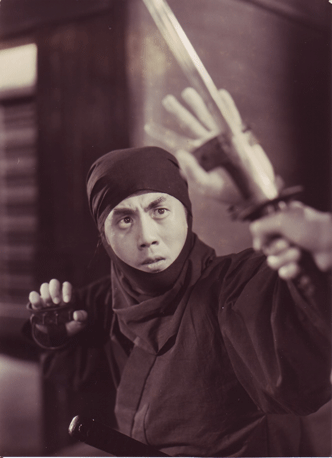 The term Ninjutsu, or 忍術, immediately evokes the image of the ninja, also called shinobi: a master of concealment, observation, evasion, strategy and adaptation. Yet beyond the popular images of cinema and modern legends, Ninjutsu is a deep Japanese martial tradition connected to survival, perception, patience and self-mastery.
This complete guide presents the meaning of Ninjutsu through its etymology, history, philosophy, traditional schools such as Togakure Ryū Ninpō 戸隠流忍法, and its martial, spiritual and practical applications.
Far more than a collection of combat techniques, Ninjutsu is a path of adaptation, inner transformation and understanding of the world. It teaches discretion, environmental awareness, emotional control, the intelligence of avoidance and the ability to act with precision at the right moment.
Born in the mountains of feudal Japan, Ninjutsu developed in a context of conflict, persecution, survival and resistance. Authentic practice connects the body, mind, nature and strategy. It invites the practitioner to cultivate silent presence, sharp awareness and stable inner strength.
I. Etymology of the Word Ninjutsu 忍術
The word Ninjutsu 忍術 is composed of two fundamental kanji that reveal the depth of this art:
- 忍 — Nin / Shinobu: perseverance, endurance, discretion, the ability to endure in silence, but also to hide or remain unseen.
- 術 — Jutsu: art, technique, method, skill or set of methods.
The kanji 忍 itself is composed of two powerful symbolic elements:
- 刃 / 刀 — Ha / Katana: the blade, danger, threat or trial.
- 心 — Kokoro: the heart, mind, consciousness and center of emotions.
The image transmitted by the kanji 忍 is that of a calm heart beneath the blade. It teaches that the true strength of the shinobi does not lie in brutality, but in inner mastery, emotional control, patience, observation and the ability to remain lucid under pressure.
Thus, from its very etymology, Ninjutsu appears as a path of patience, resilience, discretion and martial wisdom.
II. Ninjutsu: A Discipline Beyond Combat
Traditional Ninjutsu is not only a martial art. It is first and foremost a science of survival, a method of adaptation and a path of strategic intelligence. While many martial disciplines focus on direct confrontation, Ninjutsu also teaches avoidance, intelligent escape, infiltration, observation and invisible action.
Traditional Ninjutsu techniques include:
- silent movement, called shinobi-ashi 忍び足;
- camouflage in shadows, nature and the surrounding environment;
- disguise, infiltration and concealment;
- espionage, observation and memorization of the terrain;
- the creation of escape routes;
- strategy, anticipation of danger and survival in hostile environments;
- the use of traditional weapons such as shuriken, ninjatō, kusarigama or bō.
Beyond techniques, Ninjutsu develops an inner attitude: to see without being seen, to sense before danger appears, to act without noise and to disappear without leaving traces.
The practitioner learns to develop a lucid presence, able to read movements, tensions, intentions and subtle changes in the environment. The goal is not to seek confrontation, but to understand the moment in order to act with efficiency, restraint and precision.
III. Historical Origins of Ninjutsu
The origins of Ninjutsu go back to feudal Japan, in a context of war, political rivalry and social instability. Shinobi were used for espionage, reconnaissance, guerrilla tactics, protection, sabotage and secret missions.
A Birth in Times of War
From the end of the Heian period and the beginning of the Kamakura period, then especially during the Nanbokuchō and Sengoku periods, certain families and mountain communities developed unconventional methods of survival and combat. These teachings were transmitted orally, often in secrecy.
The regions of Iga 伊賀 and Kōga 甲賀 became famous as historical centers of Ninjutsu. Their mountainous terrain, autonomous villages and local organization encouraged the emergence of specialists in infiltration, intelligence gathering and indirect strategies.
The Role of Shinobi During the Sengoku Period
During the Sengoku period, daimyō called upon shinobi to gather information, infiltrate castles, observe enemies, create diversions and support military operations. Contrary to modern representations, ninja did not always wear black uniforms. Their strength often lay in their ability to blend into society under the appearance of a farmer, monk, merchant or traveler.
From Military Decline to Martial Transmission
With the relative peace established under the Tokugawa shogunate, the military use of Ninjutsu gradually declined. Some traditions were preserved within families, martial schools and specialized lineages. Today, Ninjutsu is mainly studied as a martial, historical, strategic and spiritual path.
IV. The Main Schools of Ninjutsu
Ninjutsu consists of several ryūha 流派, meaning traditional schools or lineages. Each has its own methods, principles, strategies and forms of transmission.
1. Togakure Ryū 戸隠流
Togakure Ryū Ninpō is one of the best-known schools associated with Ninjutsu. According to tradition, it was founded by Daisuke Nishina, also known as Togakure Daisuke, after the conflicts of the Genpei War.
This school emphasizes natural movement, escape, non-direct confrontation, spatial awareness, strategic concealment and adaptation. It is also connected to a spiritual dimension influenced by Japanese esoteric practices, including Mikkyo 密教.
2. Kōga Ryū 甲賀流
Kōga Ryū refers to traditions from the Kōga region, neighboring Iga. Historically, these groups were known for their infiltration tactics, family-based organization, knowledge of nature, intelligence methods and collective strategies.
3. Iga Ryū 伊賀流
Iga Ryū is often considered one of the major centers of historical Ninjutsu. The shinobi of Iga were known for their knowledge of the terrain, autonomy, use of ingenious tools, infiltration techniques and role in secret missions for various warlords.
V. Spiritual and Philosophical Values of Ninjutsu
Ninjutsu is far more than a method of combat. It is a path of consciousness, an inner way intended to refine perception of the world, the body, the mind and the invisible forces present in every situation.
The practitioner develops a calm and attentive presence. He learns to read the opponent’s intention, sense changes in rhythm, observe tensions, understand the terrain and choose the right moment to act or disappear.
Essential Values of Ninjutsu
- Patience: knowing how to wait for the right moment.
- Discretion: acting without seeking to be seen.
- Adaptation: responding naturally to change.
- Self-mastery: remaining calm under pressure.
- Observation: understanding before acting.
- Non-confrontation: avoiding unnecessary combat.
- Connection with nature: learning from the terrain, rhythm and elements.
In this sense, Ninjutsu is a non-dual martial art. It teaches both how to avoid combat and how to prevail, sometimes without even engaging in conflict.
VI. Ninjutsu Today: Tradition, Practice and Transmission
Today, Ninjutsu continues to live through dojos, schools and instructors who seek to preserve its traditional spirit while adapting it to the modern world. It can be studied as a martial art, a spiritual path, a method of personal development, a survival discipline and a living expression of Japanese culture.
In dojos such as NinjutsuKyoto, in Kyoto, Japan, the teaching of Ninjutsu is not limited to physical techniques. It also includes breathing, natural movement, perception, strategy, the study of kamae, traditional weapons, the spirit of Togakure Ryū Ninpō and the deep understanding of the kanji 忍.
Modern Ninjutsu teaches:
- awareness of the present moment;
- emotional control when facing the unexpected;
- the strategy of conscious avoidance;
- freedom through natural movement;
- mental stability under pressure;
- the ability to transform adversity into a path of learning.
VII. Traditional Equipment for Ninjutsu Practice
Ninjutsu practice requires simple, sober and functional equipment. The purpose is not appearance, but freedom of movement, discretion, safety and efficiency.
- Jikatabi: Japanese split-toe shoes, ideal for movement, grounding and silent walking.
- Tabi: Japanese socks separating the big toe.
- Keikogi or Ninjutsugi: black training uniform, flexible and resistant.
- Shinobi Shōzoku 忍び装束: traditional clothing associated with the image of the shinobi.
- Tekko: hand and wrist guards.
- Kyahan: leg guards used to secure the pants and facilitate movement.
- Belt: used to hold the uniform and symbolize commitment to practice.
NinjutsuShop.com offers a selection of equipment adapted to Ninjutsu practitioners, including tabi, jikatabi, ninja uniforms, tekko, kyahan and accessories inspired by Japanese martial traditions.
VIII. Conclusion: The Way of the Shinobi Today
Ninjutsu reminds us of an essential truth: discretion is strength, patience is strategy, silent observation can change the course of events, and adaptation allows one to survive where rigidity fails.
In a world of noise, the shinobi chooses silence. In a world of appearances, he chooses depth. In a world of confrontation, he chooses intelligence, disappearance and the right action.
Practiced sincerely, Ninjutsu becomes a path of resilience, martial wisdom and inner transformation. It is not only about learning how to fight, but learning how to see, feel, understand, adapt and preserve life.
Go Further with NinjutsuKyoto
Would you like to deepen your understanding of Togakure Ryū Ninpō, discover Ninjutsu practice in Kyoto, explore the spiritual roots of Ninjutsu or study the teachings transmitted by great masters such as Masaaki Hatsumi?
Visit the official NinjutsuKyoto blog to read detailed articles about:
- the history of Ninjutsu schools: Iga, Kōga and Togakure Ryū;
- techniques of concealment, movement and perception;
- the influence of Mikkyo, Japanese esoteric Buddhism;
- kamae, Taijutsu, traditional weapons and martial strategy;
- philosophical reflections related to the way of the Shinobi.
NinjutsuKyoto transmits a sincere approach to traditional Ninjutsu from Kyoto, Japan, with special attention to living practice, Japanese culture and the deep spirit of the kanji 忍.
Frequently Asked Questions About Ninjutsu
What is the meaning of the word Ninjutsu?
Ninjutsu 忍術 literally means the art or technique of endurance, discretion and perseverance. The kanji 忍 expresses the idea of a calm heart beneath the blade, a symbol of inner mastery.
Is Ninjutsu a Japanese martial art?
Yes. Ninjutsu is a Japanese martial tradition connected to the shinobi, survival strategies, infiltration, intelligence gathering, natural movement and unconventional combat techniques.
What is the difference between ninja and shinobi?
Both terms refer to practitioners associated with the arts of concealment. The word shinobi is more traditional in Japanese, while ninja has become more popular in modern international language.
What is Togakure Ryū Ninpō?
Togakure Ryū Ninpō 戸隠流忍法 is a traditional school associated with Ninjutsu. It emphasizes escape, strategy, natural movement, concealment and perception of the environment.
What equipment is needed to practice Ninjutsu?
Basic equipment usually includes a black training uniform or Ninjutsugi, tabi or jikatabi, a belt, tekko, kyahan and clothing that allows great freedom of movement.
Is Ninjutsu only a combat art?
No. Ninjutsu includes martial techniques, but also a philosophy of life based on patience, observation, adaptation, discretion, self-mastery and understanding of the environment.


